BEST DAY PRINTSCOURSE MAPS
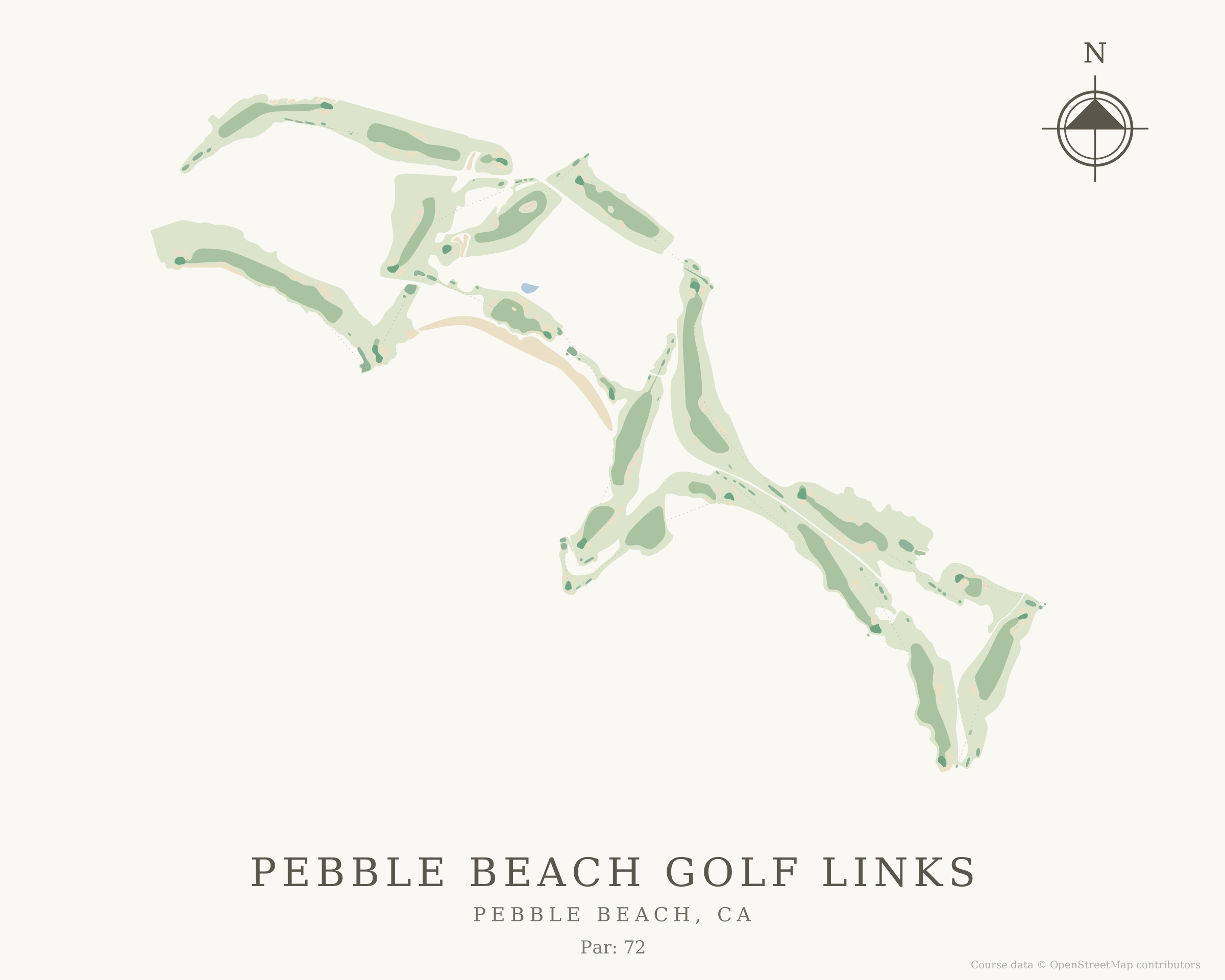
Pebble Beach Golf Links golf course map print

Traced from real course data — every bunker, green, and fairway. Course data © OpenStreetMap contributors.

Pebble Beach Golf Links

The greatest meeting of land and sea in American golf.

Pebble Beach, California · Par 72 · Est. 1919 · Jack Neville & Douglas Grant

Four designs, one course — pick the one that fits your wall.

Played here on your best day?

Add your photo and your words — the course, your memory, one piece. Make it yours →

The Story

In 1915, developer Samuel F.B. Morse — grand-nephew of the telegraph's inventor — decided the Monterey Peninsula's crown jewel shouldn't be sold off as seaside housing lots. Instead, he staked its value on a public golf course along the cliffs of Carmel Bay, and handed the design not to a famous architect but to two California State Amateur champions who had never designed a course: Jack Neville and Douglas Grant.

Neville's plan was almost humble. 'The golf course was there all the time,' he said. 'All we did was cut away the trees, put in a few sand traps, and sharpen the natural contours.' His figure-eight routing pushes the holes out along the headlands and brings them home again, so the ocean is not a view from the course — it is the course, waiting on eight of the eighteen holes.

Opened on February 22, 1919, Pebble Beach grew from regional curiosity to national stage when the U.S. Amateur came west for the first time in 1929 — the week Bobby Jones, shockingly beaten in the first round, stayed on to play Cypress Point and fell in love with the Peninsula. Bing Crosby moved his 'Clambake' pro-am here in 1947, marrying golf to Hollywood every winter. And beginning in 1972, Pebble became the first true public course to host the U.S. Open — a championship it has now hosted six times, with a seventh promised.

It remains what Morse insisted it be: open to anyone. The most exclusive-feeling course in America requires no membership at all — just a tee time, a walk along the cliffs, and a scorecard you will keep forever.

Championship Ground

U.S. Open1972, 1982, 1992, 2000, 2010, 2019Six Opens on the cliffs; no public course has hosted more.
U.S. Women's Open2023The championship's long-awaited first visit to Pebble.
PGA Championship1977Decided by the first sudden-death playoff in major history.
U.S. Amateur1929, 1947, 1961, 1999, 20181929 brought championship golf west; 1961 crowned Nicklaus.
AT&T Pebble Beach Pro-Am1947 – presentBing Crosby's Clambake, golf's original celebrity pro-am.

The Champions

Jack Nicklaus
U.S. Open · 1972

The Golden Bear won the 1961 U.S. Amateur and the 1972 U.S. Open on the same course — sealing the latter with a 1-iron that struck the 17th flagstick in the wind. He chose Pebble for his final U.S. Open in 2000.

Tom Watson
U.S. Open · 1982

From gnarly rough left of the 17th green, Watson chipped in for birdie to beat Nicklaus — 'the shot heard round the world,' and still the most replayed moment in Open history.

Tom Kite
U.S. Open · 1992

In a final-round gale that blew the field away, Kite's holed pitch on the 7th anchored an even-par 72 that won him the major his Hall-of-Fame career had been missing.

Tiger Woods
U.S. Open · 2000

Fifteen strokes. The largest margin of victory in major championship history, at the 100th U.S. Open — widely called the greatest golf ever played, and it happened here.

Graeme McDowell
U.S. Open · 2010

The Ulsterman became Europe's first U.S. Open champion in 40 years, holding steady while the leaders fell away on Pebble's closing cliffs.

Allisen Corpuz
U.S. Women's Open · 2023

In the first Women's Open at Pebble Beach, the Hawaiian closed with poise beyond her years to make history on the game's most storied public ground.

Course Lore

Pebble Beach's greens are the smallest on the PGA Tour — averaging roughly 3,500 square feet, about half the tour norm.
The 7th is the shortest hole in major championship golf: barely 100 yards, straight down to the sea, and anywhere from a wedge to a 5-iron depending on the wind.
The par-5 18th, curling along Carmel Bay's seawall, is almost universally called the greatest finishing hole in golf.
Designers Neville and Grant were amateur champions, not architects — Pebble was their first course, and for Neville, essentially his only one.
It is a public course: no membership has ever been required to play it.
The 2000 U.S. Open here produced Tiger Woods' 15-shot victory, the largest in major history — a record older than the modern majors themselves.